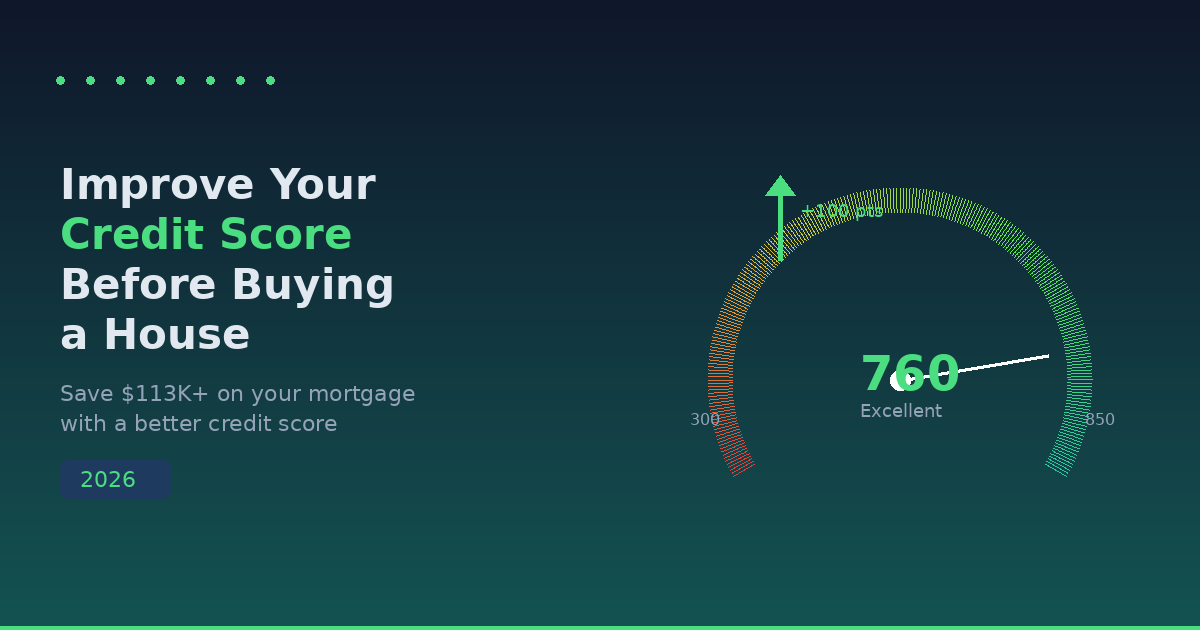
Your credit score is the single biggest factor lenders use to set your mortgage interest rate — and the difference between a mediocre score and an excellent one can cost you over $100,000 across a 30-year loan. If you're planning to buy a house in 2026, spending a few months improving your credit score before you apply could be one of the smartest financial moves you ever make.
The good news? You don't need years to make meaningful progress. With the right strategy, most people can boost their score by 50 to 100 points in three to six months. Here's exactly how to do it, along with the math that shows why it matters so much.
Key Takeaways
- A 760+ credit score gets you the best mortgage rates — currently around 6.20% for a 30-year fixed loan in April 2026
- Improving from a 620 to a 760 score saves roughly $316 per month on a $350,000 mortgage, or about $113,600 in total interest over 30 years
- Fannie Mae dropped its 620 minimum score requirement in November 2025, but individual lenders still set their own minimums
- The fastest ways to raise your score: dispute credit report errors, pay down credit card balances below 30% utilization, and stop applying for new credit
- Start at least 3–6 months before you plan to apply for a mortgage to give your score time to respond
Why Your Credit Score Matters So Much for a Mortgage
Mortgage lenders use your FICO score to decide two things: whether to approve your loan and what interest rate to charge you. They work with specific credit score tiers, and even a small jump across a tier boundary can drop your rate significantly.
Here's what the numbers look like on a $350,000 30-year fixed mortgage at April 2026 rates:
| FICO Score Range | Estimated Rate | Monthly Payment (P&I) | Total Interest Paid |
|---|---|---|---|
| 760–850 | 6.20% | $2,144 | $421,711 |
| 700–759 | 6.45% | $2,201 | $442,267 |
| 680–699 | 6.65% | $2,247 | $458,876 |
| 660–679 | 6.90% | $2,305 | $479,836 |
| 640–659 | 7.25% | $2,388 | $509,542 |
| 620–639 | 7.55% | $2,459 | $535,328 |
Look at the spread: a buyer with a 760 score pays $2,144 per month, while a buyer with a 620 score pays $2,459 for the exact same house. That $316 monthly difference adds up to $113,617 in extra interest over the life of the loan. Even moving from the 680 tier to the 760 tier saves $103 per month and more than $37,000 total.
Use our free mortgage calculator to plug in your own numbers and see how rate changes affect your monthly payment.
What Credit Score Do You Need to Buy a House in 2026?
The minimum credit score you need depends on the type of mortgage you're applying for:
Conventional loans: Most lenders require a minimum 620 FICO score. However, Fannie Mae made a significant change in November 2025 — they eliminated the hard 620 minimum for loans processed through their Desktop Underwriter (DU) system. Instead, DU now evaluates borrowers using a holistic set of factors including reserves, debt levels, income stability, and even rent payment history. That said, most individual lenders still maintain their own 620 floor.
FHA loans: You can qualify with a score as low as 580 with a 3.5% down payment, or 500 with a 10% down payment. These are the most accessible loans for buyers with lower credit.
VA loans: The VA itself doesn't set a minimum score, but most VA lenders require 580 to 620.
USDA loans: Similar to VA — no official minimum, but lenders typically want at least 620.
Meeting the minimum gets you approved, but it won't get you a good rate. The sweet spot is 760 or higher, where you'll qualify for the best available terms. If your score currently sits between 680 and 750, you're in a great position to reach that top tier with focused effort.
8 Proven Steps to Raise Your Credit Score Before Buying
1. Pull Your Credit Reports and Check for Errors
Before anything else, go to AnnualCreditReport.com and pull your reports from all three bureaus — Equifax, Experian, and TransUnion. About one in five consumers has an error on at least one credit report, according to the FTC.
Look for accounts you don't recognize, incorrect late payments, wrong balances, and duplicate entries. If you find errors, file disputes directly with the bureau reporting the incorrect information. Removing an incorrectly reported late payment or collection account can boost your score by 20 to 100 points almost immediately once the investigation resolves (typically within 30 days).
2. Pay Down Credit Card Balances (Target Under 30%)
Your credit utilization ratio — the percentage of your available credit you're currently using — accounts for roughly 30% of your FICO score. It's also one of the fastest levers you can pull.
Here's the impact by utilization level:
- Under 10% utilization: Optimal range. This is where top scores live.
- 10–30% utilization: Still good, minor impact on your score.
- 30–50% utilization: Starts to drag your score down noticeably.
- Over 50% utilization: Significant negative impact.
If you're carrying $5,000 in balances across $15,000 in total credit limits, your utilization is 33%. Paying that down to $1,500 (10%) could boost your score by 30 to 50 points within one to two billing cycles.
Pro tip: Utilization is calculated when your card issuer reports to the bureaus, which is usually on your statement closing date — not your payment due date. Pay down balances a few days before your statement closes for the fastest score impact.
3. Stop Applying for New Credit
Every credit application triggers a "hard inquiry" on your report, which typically drops your score by 5 to 10 points. More importantly, new accounts lower your average account age, which affects 15% of your score.
Starting at least six months before your planned mortgage application, put a freeze on all new credit applications. That means no new credit cards, no store financing for furniture, and no auto loans. The mortgage itself will be a hard inquiry, and you want your profile to look as stable as possible when it happens.
One exception: rate-shopping for a mortgage is fine. FICO treats multiple mortgage inquiries within a 45-day window as a single inquiry.
4. Request Credit Limit Increases
This is the flip side of paying down balances. If you can't reduce your balances quickly, increasing your credit limits achieves the same utilization improvement mathematically.
Example: You have $4,000 in balances on $10,000 in total limits (40% utilization). If your issuer bumps your limit to $16,000, your utilization drops to 25% — without paying a single dollar toward the balance.
Call your card issuers and ask for a limit increase. Many will grant one without a hard inquiry if you've been a reliable customer. Just confirm before agreeing that they'll do a "soft pull" only.
5. Become an Authorized User
If a family member or partner has a credit card with a long history of on-time payments and low utilization, ask to be added as an authorized user. Their account history gets added to your credit report, which can raise your score — sometimes by 30 or more points.
You don't even need to use the card or have it in your possession. The key requirements: the primary cardholder should have a long account history, low utilization, and zero late payments on that specific card.
6. Keep Old Accounts Open
The length of your credit history makes up 15% of your FICO score. If you're tempted to close old credit cards you no longer use — don't, at least not before your mortgage closes. Closing an account eliminates its available credit (raising your utilization ratio) and can eventually remove years of positive history from your report.
If the card has an annual fee, call and ask to downgrade it to a no-fee version. You keep the account age and credit limit without paying for a card you don't use.
7. Set Up Autopay on Everything
Payment history is the single largest factor in your FICO score at 35%. One missed payment can tank your score by 60 to 100 points, and it stays on your report for seven years.
Set up automatic payments for at least the minimum amount due on every account. This won't help you pay down debt faster, but it prevents the catastrophic score damage that a single 30-day late payment causes. Then make additional manual payments on top of autopay to actually reduce your balances.
8. Consider Experian Boost and Similar Programs
Experian Boost is a free program that adds your on-time utility, phone, and streaming service payments to your Experian credit report. For people with thin credit files (few traditional credit accounts), this can add 10 to 20 points.
Similar programs include UltraFICO (which factors in your bank account history) and the newer rent-reporting services that add your lease payments to your credit file. These won't move the needle dramatically for someone who already has a robust credit history, but they're worth trying if you need every point you can get.
A Worked Example: From 650 to 740 in 4 Months
Let's say you're planning to buy a home in six months. Your current FICO score is 650, and here's your credit profile:
- Two credit cards with a combined $8,000 limit and $5,200 in balances (65% utilization)
- One incorrectly reported 30-day late payment from two years ago
- A paid-off auto loan (closed account)
- One hard inquiry from a store credit card opened three months ago
Month 1: File a dispute on the incorrect late payment. Request credit limit increases on both cards. Sign up for Experian Boost. Estimated score impact: +10 to +15 points from limit increases and Boost.
Month 2: The bureau removes the disputed late payment. Pay down card balances from $5,200 to $3,000 (38% utilization). Estimated score impact: +40 to +60 points from the removed late payment, +10 to +15 from lower utilization.
Month 3: Continue paying down balances to $1,600 (20% utilization). No new credit applications. Estimated score impact: +15 to +25 points from utilization improvement.
Month 4: Pay balances down to $800 (10% utilization). Score has stabilized. Estimated score impact: +5 to +10 additional points.
Result: Starting score of 650, ending score of approximately 730 to 745. That jump moves you from the 640–659 rate tier (7.25%) to the 700–759 tier (6.45%) — saving roughly $187 per month and over $67,000 in total interest on a $350,000 mortgage.
Run your own scenario through our mortgage calculator to see exactly how much a rate improvement would save on your target home price.
The 2026 Credit Score Landscape: What's Changed
Two major shifts are reshaping how credit scores work for mortgage borrowers in 2026:
Fannie Mae's holistic approach: As of November 2025, Fannie Mae's Desktop Underwriter no longer uses a hard 620 score cutoff. Instead, it evaluates your entire financial picture — savings, debt levels, income stability, and property characteristics. This means a borrower with a 610 score but strong reserves and low debt might get approved where they previously would have been automatically rejected. However, your score still heavily influences your interest rate, so improving it remains critical.
New scoring models on the horizon: The mortgage industry is transitioning from Classic FICO to FICO 10T and VantageScore 4.0. These "trended" models look at whether your balances are rising or falling over a 24-month period, not just a snapshot. If you've been steadily paying down debt, these newer models will reward that trajectory — another reason to start your credit improvement now rather than waiting.
What NOT to Do Before Applying for a Mortgage
Just as important as the steps to take are the mistakes to avoid:
- Don't close credit card accounts. Even unused cards contribute to your available credit and account age.
- Don't co-sign loans for anyone. Their debt becomes your debt on paper, increasing your debt-to-income ratio.
- Don't make large purchases on credit. That new furniture can wait until after closing.
- Don't pay collections without negotiating. Ask for a "pay for delete" agreement where the creditor removes the collection from your report in exchange for payment. Paying a collection without deletion can actually reset the account's activity date.
- Don't ignore small debts. A $50 unpaid medical bill in collections hurts your score almost as much as a $5,000 one.
Your Credit Score Improvement Timeline
How far out from your planned purchase are you? Here's what's realistic at each stage:
12+ months out: You have time for major repairs. Open a secured credit card if you have thin credit, address old collections, and establish a consistent payment history. A 100+ point improvement is achievable.
6–12 months out: Focus on paying down balances, disputing errors, and avoiding new credit. A 50 to 80 point jump is realistic.
3–6 months out: Concentrate on utilization. Aggressively pay down credit card balances and request limit increases. Aim for 30 to 50 points of improvement.
Under 3 months: Pay down credit cards below 10% utilization, make sure all accounts are current, and use Experian Boost. Even 10 to 20 points might be enough to cross into a better rate tier.
If you're just starting your homebuying journey, check out our guide on how much down payment you need in 2026 and essential mortgage tips for first-time buyers.
Frequently Asked Questions
How long does it take to improve your credit score for a mortgage?
Most people can see meaningful improvement in 3 to 6 months with focused effort. Quick wins like disputing errors and paying down credit card balances can move your score within 30 to 60 days. Recovering from more serious issues like a foreclosure or bankruptcy takes 2 to 7 years.
Will checking my own credit score lower it?
No. Checking your own credit report or score is a "soft inquiry" and has zero impact on your FICO score. You can check as often as you like. Only applications for new credit ("hard inquiries") affect your score.
What's the difference between a credit score and a credit report?
Your credit report is the raw data — every account, payment, balance, and inquiry. Your credit score is a three-digit number calculated from that data. Errors in the report directly lower the score, which is why reviewing your full report is the essential first step.
Can I buy a house with a 580 credit score?
Yes, through an FHA loan. With a 580 score, you can qualify for an FHA mortgage with as little as 3.5% down. However, you'll pay mortgage insurance premiums (MIP) for the life of the loan, and your interest rate will be significantly higher than someone with a 700+ score. If possible, spend a few months improving your score before applying.
Does paying off a loan early help my credit score?
It can actually hurt slightly in the short term. Closing an installment loan reduces your credit mix and eliminates an active account. The impact is usually small (5 to 15 points), and your score recovers. But if you're within a few months of applying for a mortgage, hold off on paying off any installment loans early — keep making regular payments instead.